As someone who has worked in various organizations and seen the market from many angles, I still haven’t found a form of economic and social organization that is efficient, scalable, and human-centric.
I remembered an old interview (I think it was Vasilis Spyropoulos from Spiridoula) where, speaking about self-organization and anarchy, he drew a parallel between modern corporations and the central planning of the USSR. He described the implementation of socialism (the Soviet kind) and modern capitalism as organizational models where human freedom and individuality are oppressed in different ways.
Curiosity got the better of me, and after some time, I decided to look a little deeper into the USSR and try to merge the two in a parallel universe (based on what they share).
The USSR as a Modern Corporation
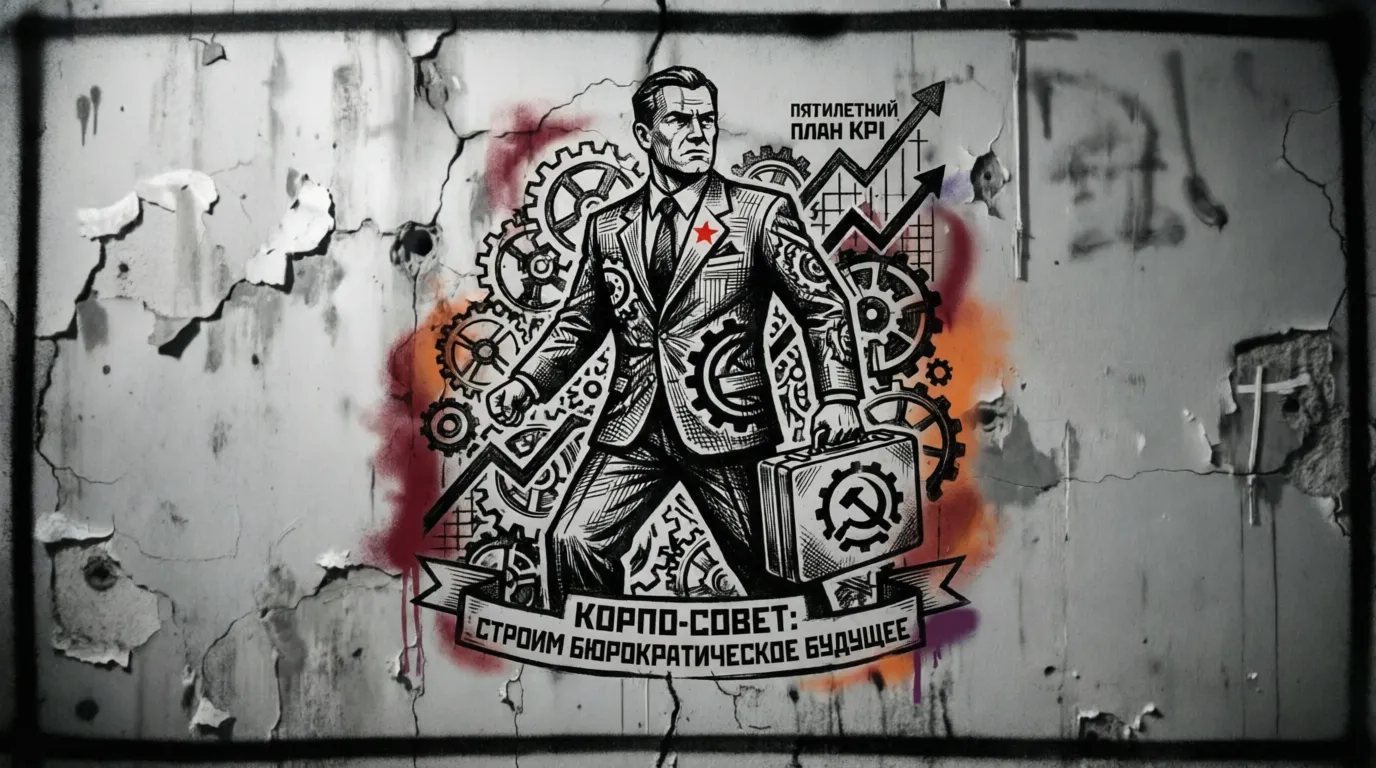
The Thought Experiment: Let’s consider the Soviet Union as a closed-type corporation, which we will henceforth call the “corpo-soviet”!
So, let’s look at the structure of the USSR through the eyes of someone with an MBA.
Ed: I know that in a short post, you can’t do an extensive analysis of the USSR. This is a light reading of the present concerning the architectural structure of the past, in relation to our “capitalist” now.
The Structure
Let’s take the structure of the modern corporation from the top. I will dare to merge the structure of the classic capitalist organization with the architectural structure of the Soviet model.
Upper Management
The Shareholder Politburo
This is essentially an individual or a group that owns the corpo-soviet. The Shareholder Politburo sets goals and decides where the corpo-soviet will head, drafting the company’s plan.
Their only desire is to maximize the benefit of the corpo-soviet—meaning their profit, and by extension, their influence and power.
General Secretary
Everyone beneath them (the Managerial Nomenklatura and the proletarian caste) works solely to satisfy whatever goal is set, and the General Secretary is the one who steers the corpo-soviet and checks if it actually achieves its target.
In many cases, the General Secretary is also part of the Shareholder Politburo.
The Managerial Nomenklatura
Here we are dealing with the directors, upper, middle, and hapless supervisors who still think they are no longer just employees. Training in corporatism begins with “I must work harder,” and one day I’ll become a “manager” too!
The poor employee knows they can never reach the Shareholder Politburo, but they can earn its favor, and so their assimilation begins, so they can cross from proletarian into the magical world of the Managerial Nomenklatura.
This caste demands bootlicking, gossiping, snitching, and office politics to move up. The larger the corpo-soviet grows, the more common it becomes for children and relatives of those already in the Managerial Nomenklatura to enter it directly.
Over time, the Managerial Nomenklatura stops caring about actual results and only looks for ways to justify its own necessity, so it can keep the perks of the position: the company car or phone, the corporate bonus, and maybe a stock option to feel juuuust a bit closer to the top.
The instinct for self-preservation, combined with an aversion to any change that might threaten their position or privileges, makes the nomenklatura caste the greatest destructive force of the very system that created them in the first place!
The Departments (Ministries)
Every department has clear activities to segment all processes. Naturally, all departments have their respective senior executives, who collectively form the Board of Directors. However, the final decision always rests with the General Secretary of the corpo-soviet.
The Proletarian Caste
Here we are talking about the workers of the corpo-soviet who do the actual work! These are the people who know the daily problems and exactly how a job gets done. They are the least fortunate in the hierarchy… These ordinary “citizens” of the corpo-soviet have no say in decision-making, not even in how they perform their work. They cannot determine company policy; they are just cogs.
Exceptional performance might be an opportunity to join the Managerial Nomenklatura, but disobedience leads to the gulags of unemployment.
Some Thoughts
All this looks like the classic structure of a corporation, with slightly altered titles. Yet, these are the common elements between the structure of the USSR and the modern corporation (excluding the gulags).
Corporate Fetishism This text was primarily written as a critique of the fetishization of the modern corporation as the ultimate means of organizing society, with the “invisible hand” of the market creating an illusion of meritocracy where the strongest survives.
The Myth of Efficiency
The fairy tale goes like this:
The corporation is the most efficient form of organizing production and labor.
But this is far from the truth, let’s look at some reasons below. According to the principles of the free market, the most successful company in an industry will maximize its profits, flooding the market, while competition will be eradicated. This will create a) monopolies and b) a tendency toward an increasingly bureaucratic structure.
The theory says that when a company reaches a point where it controls a large part of a market, it can enjoy the benefits of economies of scale. Theoretically, we would have the best products—given that this company has “beaten” its competition—and the best prices due to these economies of scale.
But our experience shows the opposite. Just like in the USSR, as the size of a corpo-soviet increases, so does its bureaucracy. As its bureaucracy increases, its efficiency decreases, and the quality of the Managerial Nomenklatura’s work decreases, until the moment comes when it collapses under its own weight. Here, of course, we could add the fact that a monopolistic company, lacking competition, has no reason to offer competitive prices or good quality in its services and products.
One could argue that in terms of planning, the USSR was more efficient, as it had five-year plans and not just pumping the stock for the next financial quarter “and we’ll see”—as happens in all large corporations.
Bullshit Jobs (and Bureaucratic Capitalism)
David Graeber, in his book Bullshit Jobs, explains the concept of “bullshit jobs” in modern capitalism. These jobs are:
- Flunkies: They exist only to make their superiors look great and feel important. Their role is purely decorative, allowing the Managerial Nomenklatura to have its “court.” Example: Receptionists at companies where nobody visits and the phone never rings.
- Goons: People who aggressively try to sell or push things that no one needs or wants. These jobs have a strong element of aggression and often exist solely because the competition has corresponding “goons” to protect their interests. Example: Corporate lawyers, telemarketers in call centers, and lobbyists.
- Duct tapers: Those who fix problems that shouldn’t even exist. If the corpo-soviet were properly organized, these jobs simply wouldn’t be there. Example: Employees manually copying data from one Excel sheet to another because no one bothered to write a simple formula (like VLOOKUP) or an automation script.
- Box tickers: Positions created exclusively so a corpo-soviet can claim it is doing something that it isn’t actually doing. Example: Corporate social responsibility departments in banks, which serve only to produce PR photos and reports on “sustainability.”
- Taskmasters: People whose job is either to supervise employees who need no supervision to do their jobs, or to invent new bullshit jobs to keep others busy. Example: “Strategy managers” in universities, or middle managers whose sole utility is sending emails asking for updates on the status of other reports.
Here we see a large part of modern inefficiency stemming from corporate structure.
Bureaucracy and Technology
Today’s corporation enjoys the privilege of modern technology, emails, and organization where distances have been eliminated. Despite all this, heavy bureaucracy continues to exist even in the most advanced tech companies, like Google.
This privilege did not exist during the USSR era, from its founding to its collapse. We can only imagine what it would be like if the immediate flow of information we have today existed when calculations were being made by GOSPLAN—the State Planning Committee.
Of course, technology would have greatly enhanced central control and the surveillance of citizens with means like cameras, the collection of data and metadata from our phones, and naturally, artificial intelligence (AI)—just as Western capitalism does today through companies like Palantir, Google, and so many others that sell such systems to governments and private companies worldwide.
The Arts
Here the comparison is a bit more complicated. In both cases, there is an “intervention” by the ruling power over human creativity, with art becoming a product serving a specific purpose. In Western culture, it has the dual property of being a commodity for profit and propaganda to affirm the dominant ideology. Something similar existed in the USSR with the establishment of the “Guilds.” Artists enjoyed the benefits and privileges offered by the state as long as they always followed the rules and state-imposed censorship.
One could, of course, juxtapose this with the persecutions artists suffered in the Western world—for example, during the Greek junta or the persecution of leftist/communist artists during the McCarthy era.
So no, the modern corporation is not sustainable, nor is it efficient. It is always either devoured by the competition or it collapses under its own weight. The top-down organization constantly shows us the insolvency and inability of such systems to work for the benefit of society as a whole.
I look at my own days within this system. The hours I lost on pointless tasks, the emails I sent just to justify my presence. Perhaps the truth lies in other systems, coordinated from the bottom up. Systems that serve the needs of society, and not the interests of the current Managerial Nomenklatura or the shareholders.
So, in the search for better ways to work and to live. Could the answer lie somewhere else?
Bibliography
- Fainsod, M. (1953). How Russia Is Ruled. Harvard University Press.
- Fitzpatrick, S. (1979). Education and Social Mobility in the Soviet Union, 1921–1934. Cambridge University Press.
- Gorlizki, Y., & Khlevniuk, O. (2020). Substate Dictatorship: Networks, Loyalty, and Institutional Change in the Soviet Union. Yale University Press.
- Graeber, D. (2018). Bullshit Jobs: A Theory. Simon & Schuster.
- Schapiro, L. B. (1970). The Communist Party of the Soviet Union (2nd ed.). Random House.
- Service, R. (2009). The Penguin History of Modern Russia: From Tsarism to the Twenty-First Century (3rd ed.). Penguin.
- Suny, R. G. (1993). The Revenge of the Past: Nationalism, Revolution, and the Collapse of the Soviet Union. Stanford University Press.
- Voslensky, M. (1984). Nomenklatura: The Soviet Ruling Class. Doubleday.

Comments (0)